

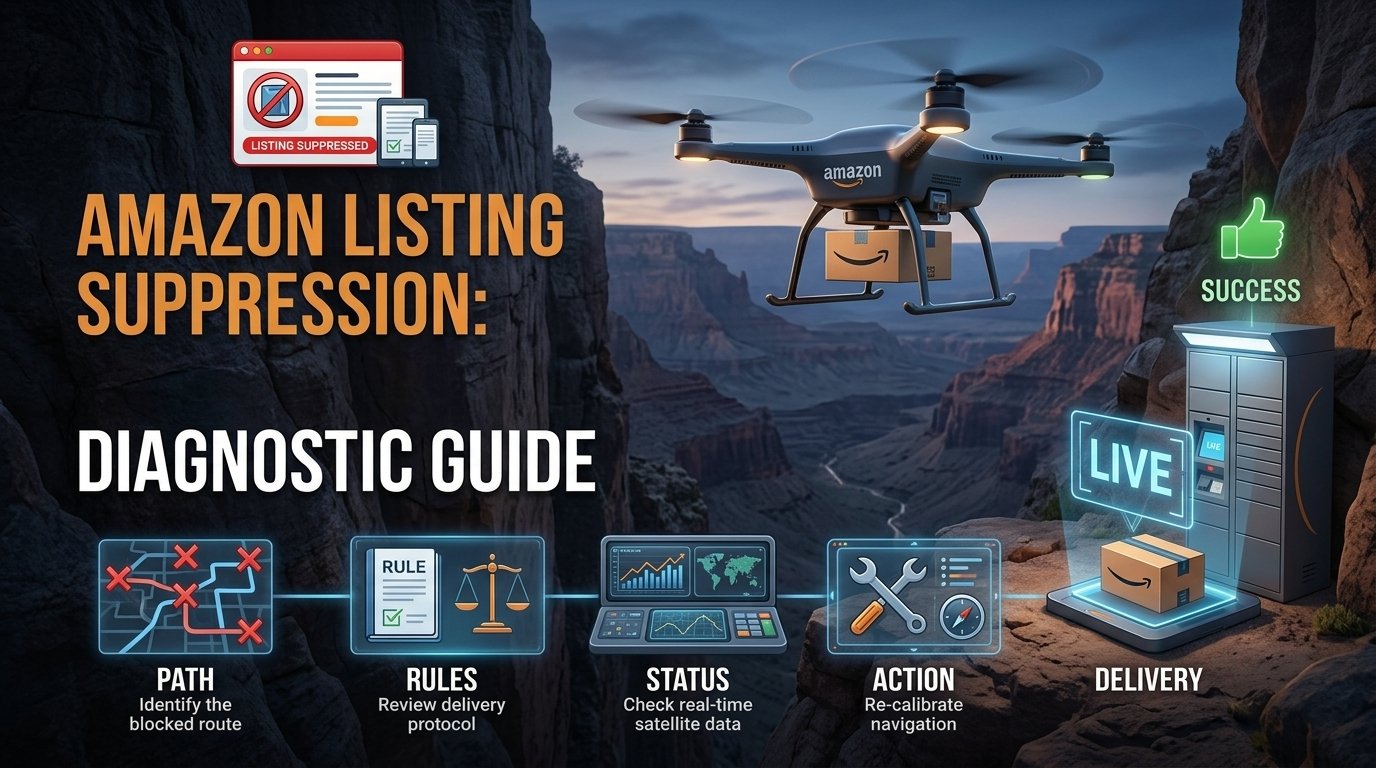
A listing doesn’t need to trigger an account suspension to stop selling. Amazon Listing suppression happens at the individual listing level: the product goes inactive, disappears from search, and often shows “currently unavailable” to shoppers, while the rest of your account stays completely healthy. Because it’s quieter than a suspension notice, a lot of sellers don’t catch it right away.
Suppression Isn’t the Same as Suspension
It’s worth separating the two clearly. A suspension affects your ability to sell at the account level. Suppression is narrower: one listing (or a handful) gets pulled from search and buy box eligibility because Amazon’s system flagged something specific about that listing, while your account itself remains active and in good standing. The fix is almost always faster than a suspension, but only if you diagnose the actual cause instead of guessing.
The Three Most Common Causes
- Flagged or restricted content, prohibited claims in the title or bullets, restricted keywords, or images that violate Amazon’s content policies (lifestyle shots with text overlays, logos that shouldn’t be there, non-compliant background)
- Pricing errors, a price that’s flagged as too high or too low relative to your own price history or competitor pricing, which can trigger an automatic suppression until it’s reviewed
- Missing or invalid required information, category-specific requirements like safety certificates, battery documentation, or compliance attributes that either weren’t submitted or were rejected
Most suppressed listings fall into one of these three, though it’s common enough to see two overlapping at once (a pricing flag alongside a missing compliance document, for example).
Step-by-Step: Diagnosing Why Your Listing Is Suppressed
Step 1: Confirm it’s actually suppression. Check Manage Inventory in Seller Central for a status of “inactive,” or check Account Health for any listing-level policy warnings. This rules out a simple stock or pricing sync issue before you go further.
Step 2: Read the actual notification, don’t skip it. Amazon almost always sends a reason code or a specific policy reference, either by email or in the case log. Sellers frequently skip straight to trying fixes without reading what was actually flagged, which means they end up fixing the wrong thing.
Step 3: Compare the listing content against current policy. Titles, bullet points, and images should be checked against Amazon’s current restricted content and creative policies, since these get updated more often than most sellers realize, and a compliant listing from a year ago can fall out of compliance without you touching it.
Step 4: Check your pricing against history and competitors. If the reason code points to pricing, compare your current price against your own recent price history and the current buy box price for the same ASIN or comparable listings.
Step 5: Check required compliance documentation. For regulated categories, verify every required document was actually submitted and accepted, not just uploaded. A rejected document often produces the same suppression outcome as never submitting one at all.
A Loop Worth Knowing About Before You Start Editing
Here’s something most guides don’t mention: once a listing is suppressed, standard content edits often don’t actually go through. Amazon’s system frequently won’t process a catalog update while the listing is in a suppressed state, which creates a loop, the listing stays suppressed because the content hasn’t been corrected, and the content can’t be corrected because the listing is suppressed. Trying to fix this through the normal listing edit flow, expecting it to just save and clear the suppression, is a common source of wasted time. In most of these cases, breaking the loop requires reaching out to Amazon’s catalog team directly and having them push the content change through manually.
Fixing Each Cause
If it’s flagged content: Revise the specific element that was flagged, don’t rewrite the whole listing. If the edit doesn’t save or doesn’t clear the suppression, that’s the loop above, open a case with the catalog team and have them apply the correction on their end.
If it’s a pricing issue: Adjust the price back within an expected range relative to your own history and the competitive set, then wait for Amazon’s system to re-evaluate, which is often automatic once the price normalizes.
If it’s missing or invalid information: Resubmit the exact document or attribute requested, in the exact format specified. Generic or slightly-off documentation is a common reason a first resubmission gets rejected again. If the correct document still doesn’t clear the suppression once accepted, that’s again a case for the catalog team to manually sync the listing.
Preventing Suppression Going Forward
- Recheck listings periodically against current content policy, not just at launch
- Set internal pricing guardrails so prices don’t drift far enough from history to trigger a flag
- Keep compliance documentation current and organized before it’s requested again at renewal
- Monitor account health regularly instead of waiting to notice a sales drop
Frequently Asked Questions
How long does listing suppression typically last?
There’s no fixed timeline. Once the underlying issue is fixed and resubmitted, many listings are reinstated within a few days, but categories requiring document review, or cases that need the catalog team to manually push a content fix, can take longer.
Does listing suppression affect my account health score?
It can, particularly if multiple listings are suppressed at once, or the cause is compliance-related. It’s narrower than a suspension, but it’s not entirely isolated from your broader account health.
Can I still edit a suppressed listing while it’s inactive?
Not as easily as you’d expect. In many cases, once a listing is suppressed, catalog content edits don’t actually go through, Amazon’s system won’t update the listing while it’s in a suppressed state. This creates a loop: the listing stays suppressed because the content hasn’t been corrected, and the content can’t be corrected because the listing is suppressed. In most of these cases, the only way to break the loop is reaching out to Amazon’s catalog team directly and having them push the content change through manually, rather than trying to fix it yourself through the standard listing edit flow.
Don’t Let a Suppressed Listing Sit
A suppressed listing is lost sales every day it stays that way, and the fix is usually faster than sellers expect once the actual cause is identified. AMZOS handles listing optimization and ongoing account monitoring so issues like this get caught and resolved before they cost you real revenue.
[…] dominant, misleading claims, missing required disclaimers in some categories) can also trigger a listing suppression, so it’s worth checking your gallery against current image policy, not just conversion […]